Home›Free vs. Paid Plagiarism Checker: What You Actually Get
Free vs. Paid Plagiarism Checker: What You Actually Get
2025-02-15·Plagiarism Detector Team
How Free Plagiarism Checkers Work
Free plagiarism checkers are widely available online and serve as a convenient first step for casual users. Most operate as web-based tools where you paste text into a browser form or upload a small document. The tool then compares your text against its database and returns a similarity percentage along with a list of matching sources.
Behind the scenes, free tools typically maintain a limited proprietary index of web pages that they have previously crawled. Some use a single search engine API with restricted query allowances. The processing happens on the provider's cloud servers, meaning your text is transmitted over the Internet and stored — at least temporarily — on third-party infrastructure. Most free tools monetize through advertising, upselling premium tiers, or using uploaded documents to expand their databases.
Limitations of Free Tools
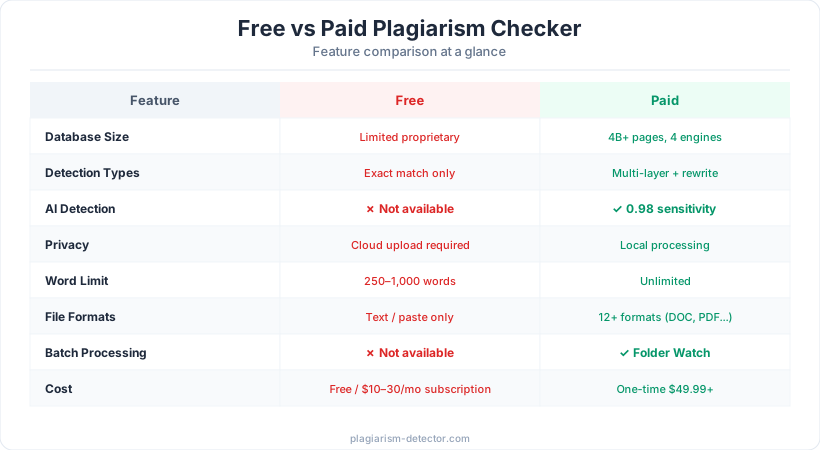
Free plagiarism checkers come with inherent constraints that affect their usefulness for anything beyond basic spot-checking. The most common limitation is word count restrictions — typically between 250 and 1,000 words per check. Checking a 5,000-word essay requires multiple submissions, each potentially returning inconsistent results.
Detection quality is another significant gap. Free tools generally rely on exact-match comparison only, meaning they can catch word-for-word copying but miss paraphrased plagiarism, character substitution tricks, and AI-generated content entirely. They also lack features like reference detection (distinguishing cited quotes from plagiarism), batch processing, and support for complex file formats beyond plain text.
Privacy is a concern that many users overlook. Free tools must sustain their operations somehow. Many include clauses in their terms of service allowing them to store and reuse uploaded content. Sensitive documents — academic research, business materials, legal texts — may be retained on external servers with no guarantee of deletion. For users handling confidential content, this is an unacceptable trade-off.
What Paid Tools Offer
Paid plagiarism checkers invest in the infrastructure and technology that free tools cannot sustain. The most immediate difference is detection coverage. Paid tools typically search across multiple search engines (Google, Bing, Yahoo, DuckDuckGo) simultaneously, accessing 4+ billion indexed pages rather than relying on a small proprietary database. This dramatically reduces the chance of missed matches.
Beyond broader search coverage, paid tools offer advanced detection technologies. Rewrite detection catches paraphrased content through semantic analysis. AI content detection identifies text generated by ChatGPT, Gemini, HuggingChat, and similar tools. Unicode anti-cheating engines detect character substitution — a technique invisible to basic checkers. These capabilities mean paid tools catch forms of plagiarism that free tools simply cannot detect.
Paid tools also remove artificial restrictions. No word count limits, no file size caps, and no per-check charges mean you can check as many documents as needed without worrying about quotas. Features like batch processing, Office integration, and offline checking modes add practical workflow value that free tools do not provide.
Text Extraction Quality: 5-Tier vs. Basic
An often-overlooked difference between free and paid tools is text extraction quality — how accurately the tool reads text from your document before comparing it. Free tools typically accept only plain text input or basic document uploads, extracting text using a single method. If that method fails or produces errors, the comparison is compromised from the start.
Advanced paid tools use a multi-tier extraction pipeline. Plagiarism Detector, for example, employs a 5-tier text extraction system: native DocX parsing first, then iFilter, OpenXML SDK, and Apache Tika as sequential fallbacks. This layered approach ensures that text is extracted accurately from even complex documents with embedded tables, footnotes, headers, or unusual formatting.
Why does this matter? Poor text extraction leads to false negatives — plagiarized passages that go undetected because the extracted text was garbled or incomplete. It also leads to false positives — clean text flagged as suspicious because extraction artifacts created spurious matches. Reliable text extraction is the invisible foundation that determines whether the entire plagiarism check is trustworthy.
Detection Coverage and Accuracy
The accuracy gap between free and paid plagiarism checkers is substantial and measurable. Free tools typically detect only exact-match plagiarism — word-for-word copying from sources in their limited database. This means they miss paraphrased plagiarism, content with substituted characters, AI-generated text, and matches from sources not in their index.
Paid tools with comprehensive technology stacks address all of these gaps. A tool that combines Internet search across multiple engines, rewrite detection, Unicode anti-cheating analysis, and AI content detection (with sensitivity as high as 0.98) provides far more complete coverage than any free alternative. The difference is not marginal — it is the difference between catching only the most obvious cheating and detecting sophisticated attempts that represent the majority of modern plagiarism.
The availability of 7 distinct check types — Internet, scientific paper databases, custom document archives, combined checks, local folder comparison, document pair analysis, and comprehensive "Everything" mode — allows users to tailor their checking to specific needs. Free tools offer, at best, a single check type against a limited database.
Check Your Text with Plagiarism Detector
Download a free demo or purchase a license to start checking for plagiarism and AI-generated content.
Making the Right Choice
Free plagiarism checkers have a legitimate place in the ecosystem. They work well for quick, informal spot-checks of short texts when privacy is not a concern and comprehensive detection is not required. A student checking a single paragraph for accidental phrasing overlap, or a blogger verifying a short excerpt, may find a free tool adequate.
For any use case where accuracy, completeness, and privacy matter, a paid tool is the appropriate choice. Educators checking student papers need detection that catches paraphrasing and AI content, not just copy-paste. Researchers need to verify originality without exposing unpublished work to third-party servers. Businesses checking content at scale need batch processing and broad file format support.
The pricing comparison often favors paid tools for regular users. A one-time purchase of $49.99 (Personal) or $69.99 (Pro) provides permanent access with no word count limits and no recurring fees. Compared to subscription-based alternatives at $10-$30 per month, a one-time purchase pays for itself within two to three months of regular use — and continues providing value indefinitely.
Frequently Asked Questions
Are free plagiarism checkers safe to use?
Free plagiarism checkers are generally safe in the sense that they will not harm your computer, but they may not be safe for your content. Many free tools store uploaded documents on their servers and may include them in their databases. If you are checking sensitive, confidential, or unpublished material, a desktop-based tool that processes documents locally provides substantially better privacy protection.
How much text can free plagiarism checkers check at once?
Most free tools limit checks to 250-1,000 words at a time. This means a typical academic paper (3,000-10,000 words) requires multiple separate submissions, often producing inconsistent results between batches. Paid tools like Plagiarism Detector impose no word count or file size limits, allowing you to check entire documents in a single operation.
Can free tools detect AI-generated content?
Most free plagiarism checkers cannot detect AI-generated content. They are designed to find matching text from existing sources, not to analyze whether text was produced by an AI model. Detecting AI content requires specialized statistical analysis technology that is typically available only in professional-grade tools with dedicated AI detection capabilities.
Why do paid plagiarism checkers produce better results?
Paid tools invest in broader source coverage (searching multiple search engines across billions of pages), more advanced detection technologies (rewrite detection, AI analysis, Unicode anti-cheating), better text extraction (multi-tier pipelines for accurate document parsing), and no artificial restrictions on document size or check frequency. These investments translate directly into higher detection rates and fewer missed matches.
Is a subscription or one-time purchase plagiarism checker better value?
For regular users, a one-time purchase is significantly better value. Subscription services cost $120-$360 per year and often include per-check or per-word fees on top. A one-time purchase tool at $49.99-$69.99 provides the same (or better) capabilities permanently with no recurring costs and no usage limits, paying for itself within the first few months.


 Stand with Ukraine!