Home›How Plagiarism Detection Works: The Technology Explained
How Plagiarism Detection Works: The Technology Explained
2025-02-15·Plagiarism Detector Team
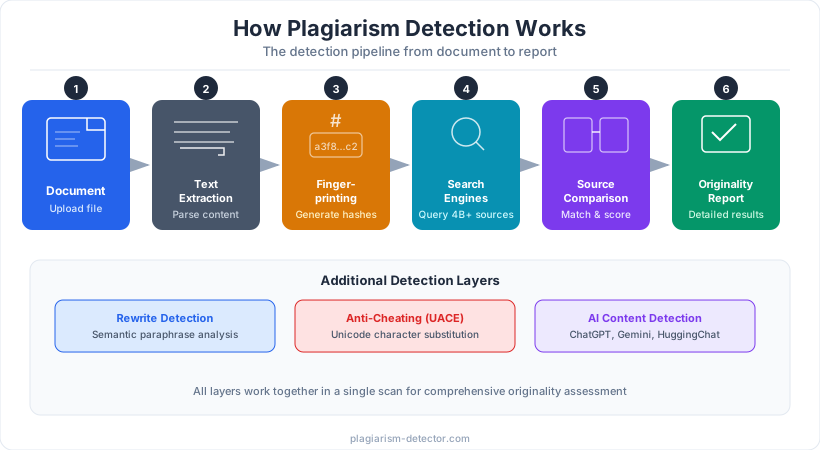
Text Extraction and Document Parsing
Before any plagiarism analysis can begin, the software must extract clean, searchable text from the submitted document. This is a more complex problem than it appears, because documents arrive in a wide variety of formats — DOC, DOCX, PDF, RTF, PPT, PPTX, TXT, ODT, and HTML, among others — each with its own internal structure of formatting, metadata, embedded objects, and encoding. A reliable text extraction pipeline must handle all of these formats consistently, producing normalized plain text suitable for comparison.
Plagiarism Detector uses a 5-tier text extraction architecture to maximize reliability. For DOCX files, the first tier parses the native DocX XML structure directly. If that fails (due to corruption or non-standard formatting), the system falls back to Microsoft's iFilter interface, then to raw OpenXML parsing, and finally to Apache Tika as a last-resort universal extractor. This cascading approach means that even damaged or non-standard documents yield usable text. The same multi-tier principle applies across all 12+ supported formats, ensuring that no document is left unprocessed.
The extraction process also handles encoding normalization — converting text from various character encodings (UTF-8, UTF-16, Windows-1252, ISO-8859 variants) into a unified internal representation. This is critical because encoding mismatches can cause identical text to appear different at the byte level, leading to missed plagiarism matches. Proper extraction lays the groundwork for every subsequent detection stage.
Text Fingerprinting
Once clean text is extracted, the detection engine breaks it into analyzable units through a process called text fingerprinting. The document is segmented into overlapping sequences of words (n-grams), and each sequence is converted into a compact numerical hash — a fingerprint. These fingerprints serve as efficient identifiers that can be rapidly compared against fingerprints from other sources without performing expensive full-text comparisons every time.
The fingerprinting algorithm must balance sensitivity against efficiency. Short n-grams (3-4 words) catch more matches but produce excessive false positives from common phrases. Longer n-grams (8-10 words) are more specific but may miss plagiarism where a few words have been changed. Advanced systems use variable-length fingerprinting combined with winnowing algorithms that select a representative subset of fingerprints, maintaining detection accuracy while keeping the comparison space manageable for documents of any size.
Search Engine Querying
With the document fingerprinted, the detection engine must compare those fingerprints against existing content across the Internet. Plagiarism Detector takes a distinctive approach: rather than relying on a single proprietary database, it queries four major search engines simultaneously — Google, Bing, Yahoo, and DuckDuckGo — accessing their combined index of over 4 billion web pages. This multi-engine strategy dramatically increases source coverage, because each search engine indexes different portions of the web and ranks results differently.
The querying process uses intelligent rotation and selection of text fragments to submit as search queries. Not every fingerprint is queried — the engine selects the most distinctive passages from the document, those most likely to return meaningful matches rather than generic phrases. Query scheduling manages rate limits and distributes requests across engines to maintain throughput. The result is a comprehensive sweep of publicly available Internet content that no single-engine approach can replicate, covering academic repositories, news archives, content farms, essay mills, and general web pages alike.
Source Retrieval and Comparison
When search engine queries return potentially matching URLs, the detection engine enters the source retrieval and comparison phase. Each candidate source page is fetched, its content is extracted and normalized (stripping HTML tags, navigation elements, headers, and footers to isolate the actual article text), and then aligned against the submitted document. This alignment uses sequence matching algorithms that identify the longest common subsequences between the two texts, accounting for minor variations in punctuation, whitespace, and formatting.
The comparison is not limited to exact matches. The engine performs fuzzy matching to identify passages where individual words have been substituted with synonyms, sentence order has been rearranged, or connecting phrases have been added or removed. This catches the most common evasion technique: superficial rewording that preserves the original meaning and structure. Each matched segment is recorded with its source URL, the percentage of overlap, and the specific text fragments that correspond, building the raw data for the originality report.
Similarity Scoring
After all sources have been retrieved and compared, the engine calculates a similarity score — a percentage representing how much of the submitted document matches external sources. This calculation is more nuanced than a simple ratio. The engine distinguishes between different types of matches: exact copies, near-matches (paraphrased passages), properly quoted and cited material, and common phrases or boilerplate text that do not indicate plagiarism.
Plagiarism Detector's reference detection system automatically identifies citations, quotations, and bibliographic references within the document and treats them differently from unattributed matches. A block of text enclosed in quotation marks and followed by a citation is flagged as a legitimate reference, not as plagiarism. This prevents inflated similarity scores that would otherwise penalize well-researched papers for their proper use of sources. The final score reflects genuine originality concerns, giving the reviewer a meaningful and actionable metric.
AI Content Detection
As AI-generated text becomes more prevalent, plagiarism detection must address content that is not copied from any existing source but is nonetheless not original human work. Plagiarism Detector includes an integrated AI content detection module with 0.98 sensitivity, capable of identifying text produced by large language models including ChatGPT, Gemini, and HuggingChat. The detection works by analyzing statistical properties of the text — word frequency distributions, sentence-level perplexity, burstiness patterns, and token probability sequences — that differ systematically between human and machine writing.
Human writing tends to exhibit greater variability in sentence length, more unpredictable word choices, and irregular patterns of complexity. AI-generated text, by contrast, gravitates toward statistically probable word sequences with more uniform sentence structure and a characteristic "smoothness" in its probability distribution. The detection model is trained on large corpora of both human and AI text, and it operates at the paragraph level to provide granular results. This analysis runs alongside traditional plagiarism detection in a single scan, so reviewers receive a unified report covering both copied content and AI-generated passages without needing separate tools or workflows.
Anti-Cheating Technology
Sophisticated users attempt to defeat plagiarism detection through various technical tricks. The most common evasion technique is Unicode character substitution — replacing Latin characters with visually identical characters from other Unicode scripts. For example, the Cyrillic letter "a" (U+0430) looks identical to the Latin letter "a" (U+0061) on screen, but they are different characters at the code point level. A naive text comparison would treat "academic" spelled with a Cyrillic "a" as a completely different word, causing the plagiarized passage to evade detection entirely.
Plagiarism Detector addresses this with its Unicode Anti-Cheating Engine (UACE). Before comparison, UACE normalizes all text by mapping visually equivalent characters across Unicode blocks — Cyrillic, Greek, Armenian, and other scripts that contain lookalike characters — back to their Latin equivalents. The engine maintains a comprehensive substitution table covering hundreds of character pairs. This normalization happens transparently during the text extraction phase, so every subsequent detection stage operates on clean, canonical text regardless of what character tricks were applied to the source document.
Beyond character substitution, UACE also detects other evasion methods including the insertion of invisible Unicode characters (zero-width spaces, zero-width joiners, soft hyphens) between words or letters, white-on-white text hidden within documents, and micro-font text inserted to break up recognizable phrases. These techniques are flagged in the originality report as deliberate manipulation attempts, alerting the reviewer that the author actively tried to circumvent detection — which is itself strong evidence of intent to plagiarize.
Check Your Text with Plagiarism Detector
Download a free demo or purchase a license to start checking for plagiarism and AI-generated content.
Originality Reports
The culmination of the detection process is the Originality Report — a detailed document that presents all findings in an organized, reviewable format. The report highlights matched passages in the submitted text, color-coded by source, with each match linked to its corresponding URL or database entry. A summary section shows the overall similarity score, the number of sources matched, the percentage of AI-generated content detected, and a breakdown of match types (exact, paraphrased, cited).
For institutions, Originality Reports can be branded with the organization's logo, providing a professional, standardized format for academic integrity records. The reports are designed to be evidence-grade — suitable for use in formal review proceedings, academic integrity hearings, or legal contexts. Each claim in the report is independently verifiable: reviewers can click through to the original source to confirm the match with their own eyes. This transparency ensures that plagiarism findings are defensible and fair, protecting both the integrity of the review process and the rights of the person whose work is being evaluated.
Desktop vs Cloud Processing
A fundamental architectural choice in plagiarism detection is whether documents are processed locally on the user's machine or uploaded to a remote cloud server. Cloud-based plagiarism checkers require users to upload their documents to the provider's servers, where the text is extracted, analyzed, and often stored in a database. This raises significant privacy and confidentiality concerns — particularly for sensitive academic research, unpublished manuscripts, legal documents, and corporate materials. Documents uploaded to cloud services may be retained, indexed, or used to train AI models, and data breaches can expose confidential content.
Plagiarism Detector operates entirely on the desktop. Documents are opened, parsed, and analyzed locally — the full text is never transmitted to any external server. Only selected text fragments (search queries) are sent to search engines for comparison, the same way a human would manually search for a phrase in a browser. This architecture provides a fundamental privacy guarantee: the complete document never leaves the user's machine. For institutions handling sensitive materials — law firms checking briefs, medical researchers reviewing papers, government agencies auditing reports — this desktop-first approach is not merely a preference but a compliance requirement. Combined with a one-time purchase model (no recurring subscription), it offers both privacy and cost predictability.
Frequently Asked Questions
How many sources does a plagiarism checker search?
Plagiarism Detector searches across the combined indexes of four major search engines — Google, Bing, Yahoo, and DuckDuckGo — which collectively cover over 4 billion web pages. This includes academic repositories, news archives, blogs, content platforms, and the general web. Additionally, institutions using the PDAS feature can search against their own private document databases. The multi-engine approach ensures far greater coverage than tools relying on a single search engine or a proprietary database alone.
Can plagiarism detection catch content that has been paraphrased?
Yes. Modern plagiarism detection goes beyond exact-match comparison. Plagiarism Detector uses rewrite detection technology that performs semantic analysis to identify passages where the wording has been changed but the underlying meaning and structure are preserved from an original source. This catches the most common form of intentional plagiarism — rewording someone else's ideas just enough to avoid word-for-word matches while failing to add proper attribution.
What file formats can plagiarism detection tools process?
Plagiarism Detector supports 12+ document formats including DOC, DOCX, PDF, RTF, PPT, PPTX, TXT, ODT, and HTML. Its 5-tier text extraction pipeline ensures reliable parsing even with damaged, complex, or non-standard files. For each format, the system uses cascading extraction methods — from native format parsing to universal fallback extractors — so that virtually any document submitted in a supported format will be successfully processed and analyzed.
Is my document stored or shared when I use a plagiarism checker?
With Plagiarism Detector, the answer is no. Because it is a desktop application, your document is opened and processed entirely on your local machine. The full document text is never uploaded to any server. Only short text fragments are sent as search queries to public search engines — identical to what you would do manually in a web browser. This is a key difference from cloud-based plagiarism checkers, which require full document uploads and may store, index, or use your content. Desktop processing provides a verifiable privacy guarantee.
How does AI content detection work alongside plagiarism detection?
Plagiarism Detector runs AI content detection and traditional plagiarism detection in a single integrated scan. The plagiarism engine checks text against Internet sources for copied or paraphrased content, while the AI detection module simultaneously analyzes the statistical properties of the text — perplexity, burstiness, and token probability patterns — to identify passages likely generated by models like ChatGPT, Gemini, or HuggingChat. The results are combined into one Originality Report that shows both similarity matches and AI-generated content flags, giving reviewers a complete picture of document authenticity without running separate tools.


 Stand with Ukraine!