Home›Consequences of Plagiarism: Academic, Legal, and Professional
Consequences of Plagiarism: Academic, Legal, and Professional
2025-02-15·Plagiarism Detector Team
Academic Consequences
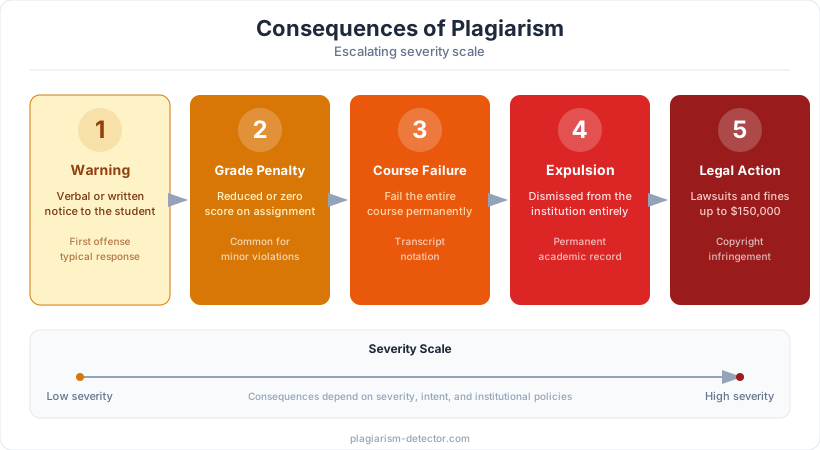
Academic consequences of plagiarism are among the most immediate and severe. At the assignment level, plagiarism typically results in an automatic zero on the work in question — with no opportunity for resubmission. In more serious cases, instructors may fail the student for the entire course, permanently marking their transcript. Universities maintain academic integrity boards that adjudicate plagiarism cases, and a single substantiated finding can trigger academic probation.
For graduate students and researchers, the stakes are even higher. A plagiarism finding during a thesis or dissertation defense can lead to revocation of the degree, even years after graduation. Doctoral candidates have had their PhDs rescinded when plagiarism was discovered in their dissertations decades later. Academic institutions now routinely scan submissions using plagiarism detection tools that search across 4+ billion Internet sources, making it far more difficult to submit unoriginal work undetected. The risk of getting caught is no longer hypothetical — it is a near certainty.
Legal Consequences
Plagiarism can cross the line from ethical violation into legal liability when it involves copyrighted material. Copyright holders have the right to pursue civil lawsuits against individuals or organizations that reproduce their work without permission or proper licensing. Statutory damages for copyright infringement in the United States can reach $150,000 per work infringed, and actual damages may be even higher when commercial profits are involved.
In publishing and journalism, legal consequences extend to both the plagiarist and their employer. Publishing houses have been sued for releasing books containing plagiarized passages, and news organizations have faced defamation and copyright claims stemming from improperly attributed content. In some jurisdictions, particularly in Europe, moral rights protections mean that even properly licensed content must be attributed to the original author — failure to do so constitutes a separate legal violation. Organizations that handle large volumes of content increasingly rely on batch processing tools like Folder Watch to scan every document before publication, reducing legal exposure.
Professional Consequences
In the workplace, professional consequences of plagiarism can be career-ending. Journalists who fabricate or plagiarize content are typically terminated immediately and blacklisted from the industry. High-profile cases — such as reporters at major newspapers caught copying from other publications — serve as cautionary examples. The damage extends beyond the individual: editors and colleagues who failed to catch the plagiarism also face scrutiny, and the publication's credibility suffers lasting harm.
In corporate and government settings, plagiarism in reports, proposals, and policy documents can result in termination, loss of professional certifications, and disqualification from future contracts. Consulting firms, law offices, and research organizations hold their staff to strict originality standards. Professionals in these fields use desktop-based plagiarism detection tools to verify their own work before submission, relying on the privacy advantage that documents are never uploaded to cloud servers — a critical consideration when handling sensitive business or legal materials.
Reputational Damage
Perhaps the most enduring consequence of plagiarism is reputational damage. In the age of digital archives and social media, a plagiarism scandal becomes a permanent part of a person's public record. Politicians have withdrawn from elections, executives have resigned from boards, and authors have had their entire body of work questioned — all because of a single instance of plagiarism that became public. The reputational cost far outlasts any formal penalty.
For institutions, the damage is equally severe. Universities that fail to enforce academic integrity policies lose credibility with accreditation bodies and prospective students. Publishers that release plagiarized work lose the trust of readers and authors. Businesses caught using plagiarized marketing content or research undermine customer confidence. The common thread is that trust, once broken, is extraordinarily difficult to rebuild. Proactive plagiarism screening — checking work before it reaches the public — is the only reliable way to protect institutional reputation.
How to Prevent Plagiarism Consequences
The most effective way to avoid the consequences of plagiarism is to prevent plagiarism before it happens. This starts with education: understanding what constitutes plagiarism, learning proper citation and paraphrasing techniques, and developing strong research habits. Writers should always track their sources during the research phase and apply the correct citation format (APA, MLA, Chicago, or others) consistently throughout their work.
Running a plagiarism check before submission provides a critical safety net. Plagiarism Detector scans documents against billions of online sources using Google, Bing, Yahoo, and DuckDuckGo simultaneously, catching matches that a single-engine search would miss. Its rewrite detection identifies paraphrased content that retains the original meaning without proper attribution, while AI content detection (with 0.98 sensitivity) flags text generated by tools like ChatGPT or Gemini. For institutions, the PDAS (Plagiarism Detector Accumulator Server) enables cross-referencing submissions against a private document database, catching internal recycling that public searches cannot detect. With support for 12+ file formats including DOC, DOCX, PDF, RTF, and PPT, the tool integrates into any existing workflow.
Check Your Text with Plagiarism Detector
Download a free demo or purchase a license to start checking for plagiarism and AI-generated content.
Frequently Asked Questions
Can you be expelled for plagiarism on a first offense?
Yes, expulsion is possible even on a first offense, though it depends on the severity and the institution's policies. Most universities reserve expulsion for cases involving extensive or deliberate plagiarism, such as submitting an entirely purchased essay. First offenses involving smaller amounts of unattributed text more commonly result in a failing grade on the assignment or course, combined with mandatory academic integrity training. However, graduate-level plagiarism and plagiarism in thesis or dissertation work is treated more harshly, and expulsion on a first offense is not uncommon at that level.
Is plagiarism a criminal offense?
Plagiarism itself is not a criminal offense in most jurisdictions — it is primarily an ethical and academic violation. However, when plagiarism involves copyrighted material, it can constitute copyright infringement, which is a civil legal matter and, in some cases, a criminal one. In the United States, willful copyright infringement for commercial gain can carry criminal penalties including fines and imprisonment. Some countries have specific laws against academic fraud that can apply to plagiarism in certain contexts.
How long does plagiarism stay on your academic record?
This varies by institution. Many universities keep plagiarism findings on academic records permanently, particularly if the violation resulted in a formal disciplinary action. Some institutions allow students to petition for record expungement after a set period (often several years) if no further violations occur. However, the practical impact can extend far beyond the formal record — graduate school applications, professional licensing boards, and employers may ask about academic integrity violations, and dishonest answers to these questions carry their own serious consequences.
Can plagiarism detection tools catch AI-generated content?
Yes, advanced plagiarism detection tools now include AI content detection capabilities. Plagiarism Detector's AI detection module achieves 0.98 sensitivity in identifying text produced by large language models such as ChatGPT, Gemini, and HuggingChat. The technology analyzes statistical patterns in word choice, sentence structure, and text distribution that distinguish machine-generated text from human writing. This works alongside traditional plagiarism detection, giving a comprehensive view of both copied and artificially generated content in a single scan.
What should you do if you are accused of plagiarism?
First, review the specific allegations carefully and gather all relevant documentation — your drafts, research notes, source materials, and any records showing your writing process. If the accusation involves unintentional plagiarism (missed citations or inadequate paraphrasing), acknowledge the error honestly and demonstrate that it was not deliberate. Most institutions have a formal appeals process, and you have the right to present your case. Going forward, use a plagiarism checker to scan your work before submission, which both prevents unintentional matches and provides documented evidence of your commitment to originality.


 Stand with Ukraine!