Home›Types of Plagiarism: A Comprehensive Guide to All Forms
Types of Plagiarism: A Comprehensive Guide to All Forms
2025-02-15·Plagiarism Detector Team
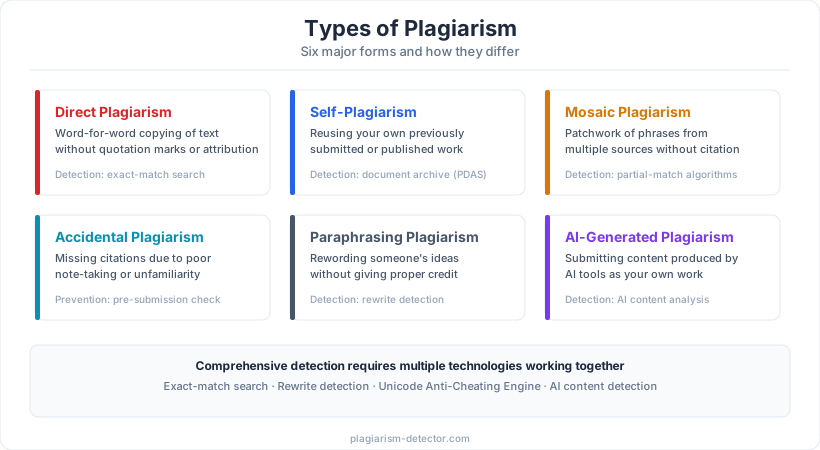
Direct Plagiarism
Direct plagiarism is the most straightforward and deliberate form — copying someone else's text word-for-word and presenting it as your own without quotation marks or attribution. This includes copying entire passages from books, articles, websites, or other students' papers. In academic settings, direct plagiarism is treated as a serious act of dishonesty and typically carries the harshest penalties, including course failure or expulsion.
Direct plagiarism is also the easiest type to detect. Text-matching algorithms compare submitted documents against billions of indexed web pages, academic databases, and published works. When identical strings of text appear in both the submitted work and an existing source, the match is flagged immediately. Even attempts to disguise copied text — such as substituting Unicode characters that look identical to Latin letters — can be caught by specialized tools like the Unicode Anti-Cheating Engine (UACE).
Self-Plagiarism
Self-plagiarism, also known as recycling or duplicate publication, occurs when an author reuses their own previously submitted or published work without disclosure. This includes submitting the same paper to multiple courses, republishing sections of a previous article in a new publication, or reusing substantial portions of a thesis in a journal submission. While it may seem harmless — after all, you wrote the original — self-plagiarism violates the expectation that every submission is original work.
In academia, self-plagiarism is particularly problematic because assignments are designed to demonstrate new learning and original thought. In publishing, it distorts the scholarly record and can violate copyright agreements with publishers who hold rights to previously published work. Many journals now explicitly screen for self-plagiarism during peer review. Institutional document databases such as PDAS (Plagiarism Detector Accumulator Server) help organizations maintain archives of previously submitted work, making self-plagiarism detection across semesters and departments practical.
Mosaic Plagiarism
Mosaic plagiarism, sometimes called patchwork plagiarism, is one of the most deceptive forms. It involves taking phrases, sentences, or ideas from multiple sources and weaving them together — often with minor word changes — to create what appears to be an original piece of writing. The plagiarist may change a word here or restructure a sentence there, but the ideas, structure, and often the phrasing remain borrowed without proper citation.
This type is harder to detect than direct plagiarism because no single passage matches a source exactly. Instead, the text is a patchwork of partially modified fragments from various origins. Detecting mosaic plagiarism requires sophisticated algorithms that can identify partial matches and patterns of similarity across multiple sources simultaneously. Effective detection tools search across 4+ billion Internet sources and use multiple search engines to maximize the likelihood of finding each borrowed fragment, however cleverly it has been integrated.
Accidental Plagiarism
Accidental plagiarism occurs when a writer unintentionally fails to properly cite sources, misattributes information, or unknowingly uses phrasing too close to the original. This commonly happens when students take poor notes during research — failing to mark which words are direct quotes versus their own summaries — or when they are unfamiliar with the citation conventions required in their discipline.
Despite being unintentional, accidental plagiarism is still treated as plagiarism by most institutions. Intent does not excuse the failure to attribute sources. The best defense against accidental plagiarism is careful note-taking, thorough knowledge of citation standards, and running a final plagiarism check before submission. Checking your own work before turning it in allows you to catch overlooked citations or passages that are too close to the source, giving you the opportunity to correct them.
Paraphrasing Plagiarism
Paraphrasing plagiarism happens when someone rewrites another person's ideas in different words but fails to provide proper attribution. Unlike direct plagiarism, the wording is changed — sometimes substantially — but the underlying ideas, arguments, or structure are taken from the source without credit. Many students mistakenly believe that changing the words is enough, but proper academic practice requires citing the source of the idea regardless of how it is expressed.
Detecting paraphrasing plagiarism is one of the most challenging tasks in plagiarism detection because the text will not match the original word-for-word. Standard text-matching alone is insufficient. Advanced rewrite detection technology analyzes semantic similarity — the meaning and structure behind the words — to identify content that has been paraphrased without attribution. This capability is essential for any serious plagiarism detection workflow, as paraphrasing is one of the most common forms of plagiarism encountered in academic and professional writing.
AI-Generated Plagiarism
AI-generated plagiarism is the newest and fastest-growing form. It involves submitting content produced by large language models — such as ChatGPT, Gemini, or HuggingChat — as one's own original work. Because AI-generated text is not copied from any single source, it evades traditional text-matching detection entirely. The output is statistically unique, yet it is not the product of the submitter's own thinking, research, or learning.
Detecting AI-generated content requires a fundamentally different approach. AI detection algorithms analyze the statistical patterns of text — such as token predictability, perplexity, and burstiness — to determine whether content was likely produced by a machine rather than a human. Plagiarism Detector includes AI content detection with 0.98 sensitivity, capable of identifying output from ChatGPT, Gemini, HuggingChat, and other language models. Combining traditional plagiarism detection with AI content analysis in a single scan provides the most comprehensive originality assessment available.
Check Your Text with Plagiarism Detector
Download a free demo or purchase a license to start checking for plagiarism and AI-generated content.
How to Detect Each Type
Different types of plagiarism require different detection strategies. Direct plagiarism is caught by exact-match text comparison against large databases of published content. Mosaic plagiarism requires partial-match algorithms that can identify borrowed fragments even when embedded in otherwise original text. Paraphrasing plagiarism demands rewrite detection that analyzes meaning rather than surface-level wording. AI-generated plagiarism calls for statistical text analysis that evaluates patterns characteristic of machine-generated output.
A comprehensive plagiarism detection tool addresses all of these types in a single workflow. Plagiarism Detector searches across 4+ billion Internet sources using Google, Bing, Yahoo, and DuckDuckGo simultaneously, combines rewrite detection and UACE anti-cheating technology, and integrates AI content detection — all within a desktop application that keeps your documents private. Supporting 12+ file formats (DOC, DOCX, PDF, RTF, PPT, PPTX, TXT, ODT, HTML, and more) and batch processing via Folder Watch, it provides thorough coverage regardless of document type or volume.
Frequently Asked Questions
What is the most common type of plagiarism?
Paraphrasing plagiarism and accidental plagiarism are the most common types encountered in academic settings. Many students understand that direct copying is wrong but do not realize that restating ideas without citation is also plagiarism. Poor note-taking habits and unfamiliarity with citation standards contribute to the prevalence of these forms. As AI tools become more widespread, AI-generated plagiarism is rapidly increasing in frequency.
Is self-plagiarism really considered plagiarism?
Yes. Although you are the original author, most academic institutions and publishers consider reusing previously submitted work without disclosure to be a form of plagiarism. The expectation is that each submission represents new, original effort. If you want to build on your prior work, you should cite it properly and disclose that portions have been previously submitted or published. Some institutions allow this with explicit permission from the instructor.
Can plagiarism checkers detect AI-generated content?
Advanced plagiarism checkers now include AI content detection capabilities. Plagiarism Detector, for example, uses statistical analysis to identify text generated by models like ChatGPT, Gemini, and HuggingChat with 0.98 sensitivity. This is separate from traditional text-matching and addresses the unique challenge that AI-generated text does not copy from any single source but is still not the student's original work.
How does mosaic plagiarism differ from paraphrasing plagiarism?
Mosaic plagiarism involves taking fragments from multiple sources and combining them into a new text, often with minor wording changes, without citing any of the sources. Paraphrasing plagiarism involves restating ideas from a single source in different words without attribution. The key difference is scope: mosaic plagiarism draws from many sources to assemble a patchwork, while paraphrasing plagiarism typically rewrites a specific source's ideas.
Can accidental plagiarism still lead to academic penalties?
Yes. Most academic integrity policies do not distinguish between intentional and unintentional plagiarism — the failure to properly attribute sources is a violation regardless of intent. Penalties may be lighter for first-time accidental offenses, but they can still include grade reductions or mandatory academic integrity training. The best way to avoid accidental plagiarism is to develop careful research habits and check your work with a plagiarism detection tool before submission.


 Stand with Ukraine!