Home›Plagiarism Statistics 2025: Facts, Trends, and Research Data
Plagiarism Statistics 2025: Facts, Trends, and Research Data
2025-02-15·Plagiarism Detector Team
Global Plagiarism Statistics
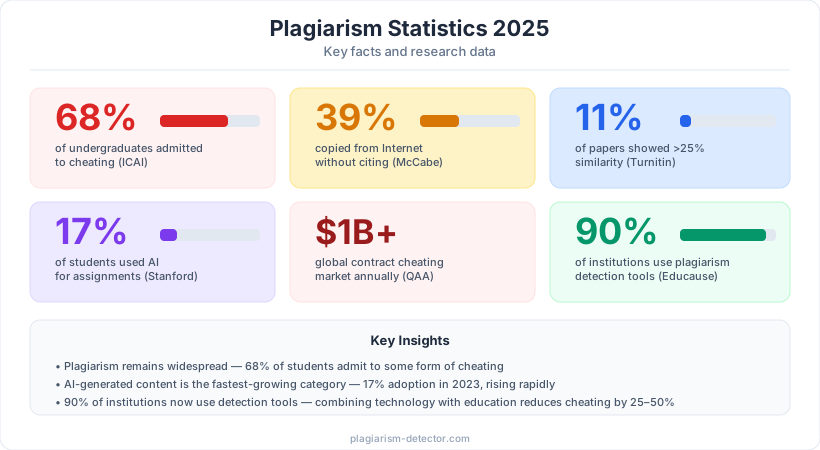
Plagiarism is a worldwide problem that affects every sector producing written content. According to research published by the International Center for Academic Integrity (ICAI), approximately 68% of undergraduate students admitted to engaging in some form of written cheating, including plagiarism, during their academic careers. This figure has remained remarkably consistent across multiple survey waves spanning over two decades of research by Donald McCabe and colleagues.
A large-scale meta-analysis published in PLOS ONE (Pupovac & Fanelli, 2015) examined self-reported plagiarism rates across 54 studies and found a pooled prevalence of approximately 30% of students admitting to at least one instance of plagiarism. The study noted significant variation by region, with some countries reporting rates above 50% and others below 10%, reflecting differences in cultural attitudes, institutional enforcement, and awareness of plagiarism norms.
The problem extends beyond academia. A 2019 report by iThenticate (a Turnitin company) surveying editors and researchers found that 1 in 6 submitted manuscripts to academic journals contained significant text overlap with previously published material. In the journalism and publishing industries, plagiarism scandals continue to surface regularly, with high-profile cases reported at major news organizations in recent years.
Academic Plagiarism Rates
Academic dishonesty research consistently reveals that plagiarism is pervasive across all levels of education. The McCabe Center for Academic Integrity (formerly the International Center for Academic Integrity) has collected data from over 71,000 undergraduate students and 17,000 graduate students across North America. Their findings indicate that 39% of undergraduates admitted to paraphrasing or copying a few sentences from an Internet source without citing it, and 62% of undergraduates admitted to at least one serious cheating behavior on written assignments.
A 2023 survey by Turnitin reported that among submissions processed through their system, approximately 11% of student papers contained significant text overlap (above 25% similarity) from unattributed sources. A separate study by Bretag et al. (2019) published in Studies in Higher Education surveyed 14,086 students across eight Australian universities and found that 6.5% admitted to purchasing or outsourcing assignments (contract cheating), a particularly severe form of academic fraud.
Graduate-level plagiarism is less studied but not uncommon. The Office of Research Integrity (ORI) in the United States has investigated hundreds of cases of research misconduct since its establishment, with plagiarism and data fabrication as the leading categories. A study by Heitman and Litewka (2011) published in Developing World Bioethics found that plagiarism in scientific publications was more prevalent in developing countries, partly due to language barriers and differing academic norms.
AI-Generated Content Trends
The release of ChatGPT in November 2022 marked a turning point in academic integrity. A survey conducted by Stanford University's Human-Centered Artificial Intelligence research group found that approximately 17% of surveyed college students reported using AI tools for assignments in the 2022-2023 academic year. Subsequent surveys suggest this figure has increased substantially.
Turnitin reported in 2024 that their AI detection system flagged between 6% and 11% of submitted student papers as containing substantial AI-generated content (defined as 80% or more AI-written text). A survey by BestColleges (2023) found that 56% of college students had used AI tools for coursework, with about half of those acknowledging that their institutions considered such use to be a form of cheating or plagiarism.
The challenge of AI-generated content extends beyond education. A 2024 analysis by Originality.AI estimated that a significant and growing percentage of newly published web content shows markers of AI generation. This creates new challenges for plagiarism detection tools, which must now distinguish between human-written original text, plagiarized human-written text, and AI-generated text — three distinct categories that require different detection approaches.
Plagiarism in Publishing and Journalism
Plagiarism in professional publishing carries consequences that extend well beyond individual careers. A study by Fang, Steen, and Casadevall (2012) published in the Proceedings of the National Academy of Sciences analyzed 2,047 retracted biomedical papers and found that 9.8% of retractions were attributed to plagiarism, while fraud and duplicate publication accounted for the majority. The study established that retraction rates in scientific literature had increased tenfold since 1975.
In journalism, the Poynter Institute and other media ethics organizations have documented a pattern of high-profile plagiarism cases at major news organizations. Cases have involved reporters at The New York Times, The Washington Post, CNN, and Der Spiegel, among others. A 2014 study by Honeycut and Freberg found that journalist plagiarism cases increased public distrust of the affected news organizations and of media in general.
Digital publishing has made plagiarism both easier to commit and easier to detect. Content scraping tools can replicate articles across thousands of websites within hours of publication. At the same time, plagiarism detection tools make it straightforward for publishers to check incoming content against billions of indexed web pages and flag potential issues before publication.
Financial Impact of Plagiarism
The financial consequences of plagiarism affect individuals, institutions, and industries. In academic settings, students caught plagiarizing may lose scholarships, face tuition-related costs from course failures, or incur expenses related to legal proceedings. A 2020 study by Quality Assurance Agency for Higher Education (QAA) in the UK estimated that the global contract cheating market — where students pay third parties to write their assignments — was worth over $1 billion annually.
For publishers and businesses, plagiarism can result in direct financial liability. Copyright infringement lawsuits in the United States routinely result in statutory damages of $750 to $30,000 per work infringed, with willful infringement penalties reaching $150,000 per work under the Copyright Act. The Authors Guild and similar organizations report that content theft costs authors and publishers hundreds of millions of dollars annually in lost revenue.
Institutions also bear costs. Universities invest substantial resources in academic integrity infrastructure — plagiarism detection software licenses, integrity officers, investigation processes, and educational programs. According to institutional budget disclosures, large universities may spend $50,000 to $300,000 or more annually on plagiarism detection services alone, particularly those using subscription-based per-student pricing models.
Check Your Text with Plagiarism Detector
Download a free demo or purchase a license to start checking for plagiarism and AI-generated content.
Prevention and Detection Adoption
Plagiarism detection technology has become standard practice in education and publishing. According to a 2022 survey by Educause, over 90% of higher education institutions in the United States and United Kingdom now use some form of plagiarism detection software. Adoption rates are growing rapidly in Asia, the Middle East, and Latin America as academic integrity awareness increases globally.
The integration of AI content detection into plagiarism checking workflows represents the newest evolution in prevention technology. Institutions and publishers are increasingly seeking tools that combine traditional plagiarism detection with AI analysis in a single platform. Desktop-based tools offer an additional advantage for privacy-conscious organizations, as they allow documents to be checked without uploading them to external cloud servers.
Education remains the most effective long-term prevention strategy. Research by McCabe, Butterfield, and Trevino (published in their book Cheating in College, Johns Hopkins University Press, 2012) found that institutions with honor codes and active integrity education programs experienced cheating rates 25-50% lower than those relying solely on detection and punishment. The most effective approach combines clear policies, educational outreach, and reliable detection technology.
Frequently Asked Questions
How common is plagiarism in universities?
Research by the International Center for Academic Integrity indicates that approximately 68% of undergraduates admit to some form of written cheating, with 39% admitting to copying or paraphrasing Internet sources without citation. Actual plagiarism rates may be higher than self-reported figures, as self-reporting tends to underestimate dishonest behavior.
What percentage of student papers contain plagiarism?
Turnitin data indicates that approximately 11% of student submissions contain significant text overlap (above 25% similarity) from unattributed sources. However, some level of text matching is normal and expected in properly cited academic work. The distinction between plagiarism and legitimate citation is crucial when interpreting similarity scores.
How much AI-generated content is being submitted in schools?
Estimates vary, but Turnitin reported in 2024 that 6-11% of student submissions contained substantial AI-generated content. A BestColleges survey found that 56% of college students had used AI tools for coursework, though not all usage constitutes academic dishonesty — some institutions permit AI assistance for certain tasks.
How much does plagiarism cost publishers and authors?
Copyright infringement can result in statutory damages of $750 to $150,000 per infringed work in the United States. The global contract cheating market alone exceeds $1 billion annually. Individual plagiarism cases at publishers have resulted in lawsuit settlements, book recalls, and career-ending reputational damage for authors.
Do plagiarism detection tools actually reduce cheating?
Yes. Research shows that institutions using plagiarism detection tools experience lower plagiarism rates, particularly when detection is combined with education and clear integrity policies. The deterrent effect is well documented: students who know their work will be checked are significantly less likely to plagiarize. McCabe's research found that combining honor codes with detection technology reduces cheating by 25-50%.


 Stand with Ukraine!