Home›What is Plagiarism? A Complete Guide for Students and Educators
What is Plagiarism? A Complete Guide for Students and Educators
2025-02-15·Plagiarism Detector Team
Definition of Plagiarism
Plagiarism is the act of presenting someone else’s work, ideas, or expressions as your own without proper acknowledgment. It encompasses a wide range of behaviors — from copying text word-for-word to paraphrasing ideas without citation. In academic settings, plagiarism is considered a serious breach of integrity that can result in failing grades, suspension, or expulsion.
The concept extends beyond simple copying. Plagiarism includes submitting purchased essays, using AI tools to generate academic work, recycling your own previously submitted work (self-plagiarism), and inadequately citing sources even when paraphrasing. Understanding what constitutes plagiarism is the first step toward preventing it.
Modern plagiarism detection tools like Plagiarism Detector can identify even sophisticated forms of plagiarism by searching across 4+ billion Internet sources using multiple search engines (Google, Bing, Yahoo, and DuckDuckGo) simultaneously. Advanced features such as the Unicode Anti-Cheating Engine (UACE) catch attempts to disguise copied text through character substitution.
Why Plagiarism Matters
Plagiarism undermines the fundamental principles of education, research, and intellectual discourse. In academia, it defeats the purpose of learning — assignments are designed to develop critical thinking, analytical skills, and the ability to synthesize information from multiple sources. When students plagiarize, they shortcut the learning process entirely.
Beyond education, plagiarism has serious legal and professional consequences. Copyright infringement can lead to lawsuits and financial penalties. In journalism and publishing, plagiarism can end careers. In business, using plagiarized content can damage brand reputation and lead to legal action from the original content creators.
Common Forms of Plagiarism
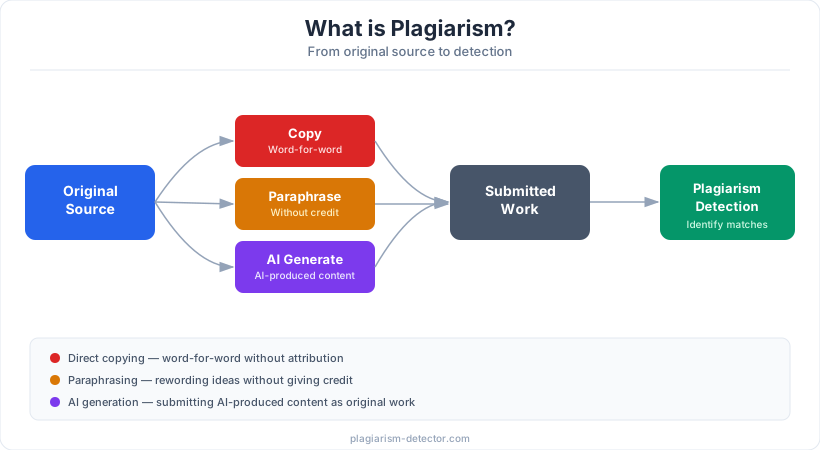
Plagiarism takes many forms, ranging from obvious to subtle. Direct plagiarism involves copying text word-for-word without quotation marks or attribution. Mosaic plagiarism (or patchwork plagiarism) involves taking phrases from multiple sources and combining them without proper citation. Paraphrasing plagiarism occurs when someone rewrites another’s ideas in different words without giving credit.
More subtle forms include self-plagiarism (reusing your own previously published work), accidental plagiarism (failing to cite sources due to carelessness or lack of knowledge), and increasingly, AI-generated plagiarism — submitting content produced by tools like ChatGPT as original work.
Each form requires different detection methods. Word-for-word copying is caught by exact-match search algorithms. Paraphrasing plagiarism requires rewrite detection technology. AI-generated content requires specialized statistical analysis. Comprehensive plagiarism checkers address all of these types in a single scan.
Plagiarism in Academia
Academic plagiarism is the most commonly discussed form, affecting students at all levels from high school to doctoral programs. Universities typically maintain strict academic integrity policies with clear penalties for plagiarism violations. Common consequences include failing the assignment, failing the course, academic probation, and in severe or repeated cases, expulsion.
Educators use plagiarism detection tools to check student submissions before grading. Tools with features like Folder Watch batch processing and Microsoft Office integration (Word and PowerPoint add-ins) make it practical to check every submission, even in large classes. The PDAS (Plagiarism Detector Accumulator Server) feature allows institutions to maintain their own database of previously submitted documents for cross-referencing.
Plagiarism in Business and Publishing
In the business world, plagiarism can take the form of copying marketing materials, website content, product descriptions, or internal reports from competitors or other sources. This exposes companies to copyright infringement claims and damages credibility with customers and partners.
Publishers face an escalating challenge with the rise of AI-generated content. Content farms can produce thousands of articles that may contain plagiarized fragments or be entirely AI-generated. Professional publishers use plagiarism detection tools that support batch processing and multiple file formats (DOC, DOCX, PDF, RTF, PPT, PPTX, TXT, ODT, HTML) to maintain quality standards across large content volumes.
How to Detect Plagiarism
Plagiarism detection works by comparing submitted text against a vast database of existing content. Modern plagiarism checkers use search engine APIs to check text against billions of web pages, academic databases, and published materials. The most thorough tools use multiple search engines simultaneously to maximize coverage.
Advanced detection goes beyond simple text matching. Rewrite detection algorithms identify paraphrased content that maintains the same ideas in different words. The UACE (Unicode Anti-Cheating Engine) catches character substitution tricks where students replace Latin characters with visually identical Unicode characters from other scripts (for example, replacing the Latin letter “a” with a Cyrillic “а”) to fool basic text comparison.
AI content detection adds another layer by analyzing the statistical patterns of text to determine whether it was likely produced by a language model like ChatGPT, Gemini, or similar tools. Integrated solutions that combine traditional plagiarism detection with AI content analysis provide the most comprehensive assessment of document originality.
Check Your Text with Plagiarism Detector
Download a free demo or purchase a license to start checking for plagiarism and AI-generated content.
How to Prevent Plagiarism
Preventing plagiarism starts with education. Understanding what constitutes plagiarism, learning proper citation practices, and developing strong research and writing skills are the foundation. Students should learn citation formats (APA, MLA, Chicago, Harvard) appropriate to their field and practice paraphrasing techniques that genuinely restate ideas in their own words.
Using a plagiarism checker before submission is the most effective last-line defense. Running your document through a comprehensive checker like Plagiarism Detector identifies any unintentional similarities or missed citations, allowing you to correct them before submission. The desktop-based approach ensures your documents remain private — they are never uploaded to external cloud servers, protecting sensitive academic or business content.
Frequently Asked Questions
What percentage of plagiarism is acceptable?
There is no universal threshold. Most academic institutions consider any uncited borrowed content to be plagiarism. Some allow a small percentage (typically 10-15%) of properly quoted and cited material. The acceptable level depends on the type of work, the institution’s policies, and the context. Plagiarism checkers help identify all matched content so authors can ensure proper attribution.
Can plagiarism checkers detect paraphrasing?
Advanced plagiarism checkers can detect paraphrased content. Plagiarism Detector uses rewrite detection technology that analyzes semantic similarity, not just exact word matches. This catches content that has been reworded but retains the original ideas and structure without proper attribution.
Is using a plagiarism checker considered cheating?
No. Using a plagiarism checker is a responsible practice that demonstrates academic integrity. Many institutions encourage or require students to check their work before submission. It helps identify unintentional similarities and ensures proper citation. Plagiarism checkers are tools for quality assurance, not cheating.
Can plagiarism occur with images or code?
Yes. Plagiarism is not limited to text. Using images, graphics, code, data, musical compositions, or any creative work without proper attribution constitutes plagiarism. While text-based plagiarism checkers focus on written content, the principles of attribution and original work apply to all forms of intellectual property.
What is the difference between plagiarism and copyright infringement?
Plagiarism is an ethical violation — presenting someone’s work as your own. Copyright infringement is a legal violation — using copyrighted material without permission. They often overlap but are distinct: you can plagiarize public domain work (ethical issue, no legal issue), and you can infringe copyright while properly citing the source (legal issue, no ethical issue).


 Stand with Ukraine!